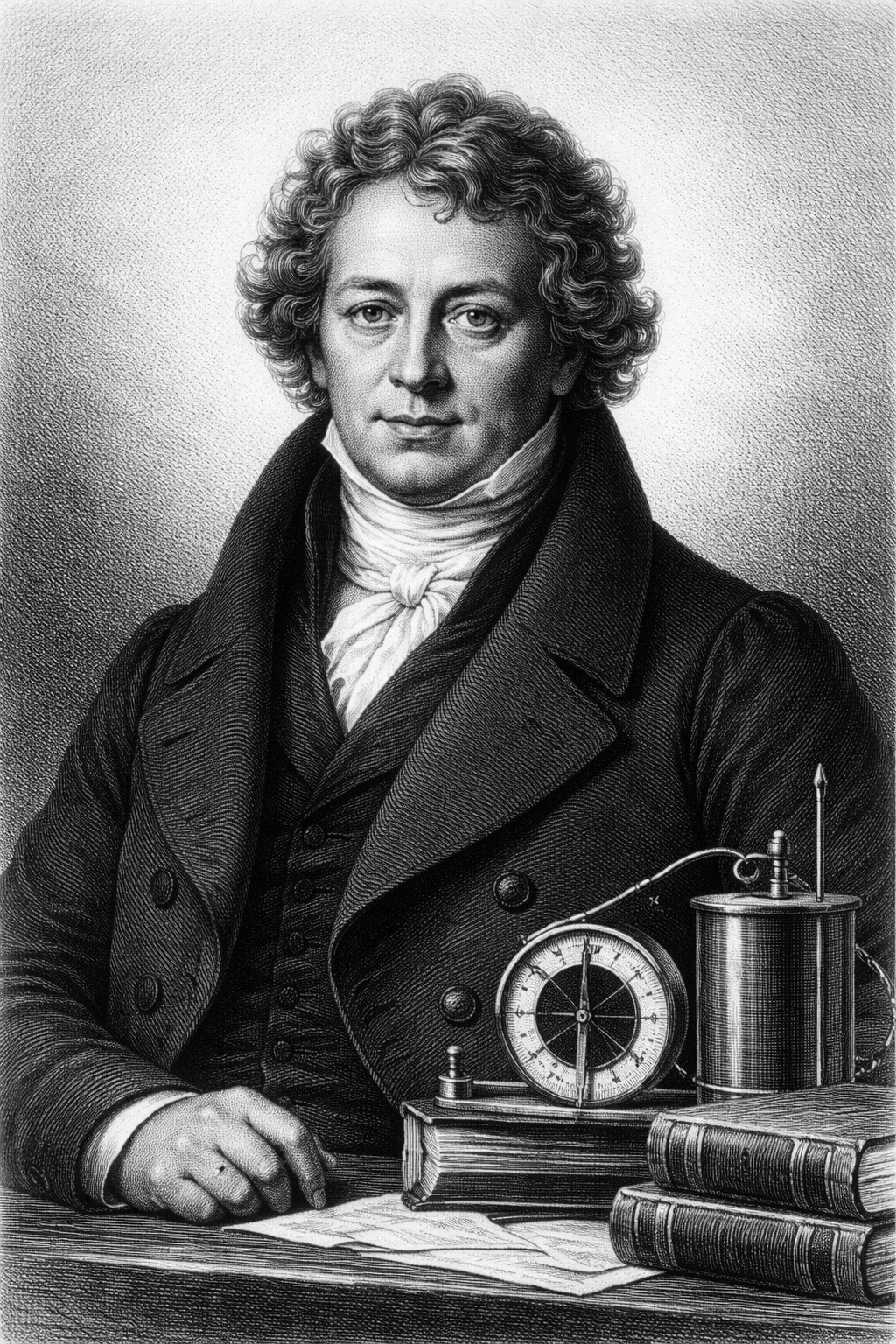
André-Marie Ampère
André-Marie Ampère was one of the first scientists to reveal the connection between electricity and magnetism. His experiments showed that an electric current creates a magnetic field and can interact with other currents. Today, the unit used to measure electric current — the ampere — bears his name.
In electrical engineering and electronics we constantly use units such as volts, amperes, and ohms.
Behind each of these names stands a scientist whose discoveries helped humanity understand the nature of electricity.
One of the most important figures in this field was the French physicist André-Marie Ampère. His research laid the foundations of a new branch of physics known as electrodynamics, which studies the relationship between electric currents and magnetic fields.
Ampère’s work demonstrated that electric current is not only the movement of charges through a conductor — it also produces magnetic effects and can interact with other currents.
Electricity at the Beginning of the 19th Century
At the beginning of the nineteenth century, scientists had already made several important discoveries about electricity.
The invention of the voltaic pile by Alessandro Volta allowed researchers to generate a continuous electric current for the first time. This made it possible to conduct systematic experiments with electricity.
However, many aspects of electric phenomena were still poorly understood.
Everything changed in 1820 when the Danish physicist Hans Christian Ørsted discovered that a wire carrying electric current could deflect the needle of a compass.
This observation revealed a surprising fact: electricity and magnetism are connected.
The discovery immediately attracted the attention of scientists across Europe, including André-Marie Ampère.
Who Was André-Marie Ampère?
André-Marie Ampère was born in France in 1775.
From an early age he showed exceptional intellectual abilities. He was largely self-taught and spent many years studying mathematics, philosophy, and science through books.
Later he became a professor of mathematics and physics and devoted his life to scientific research.
Ampère had wide interests and worked in several areas of science, but his most significant contributions were related to the study of electricity.
Experiments with Electric Currents
Inspired by Ørsted’s discovery, Ampère began conducting his own experiments.
He investigated how wires carrying electric current interact with each other.
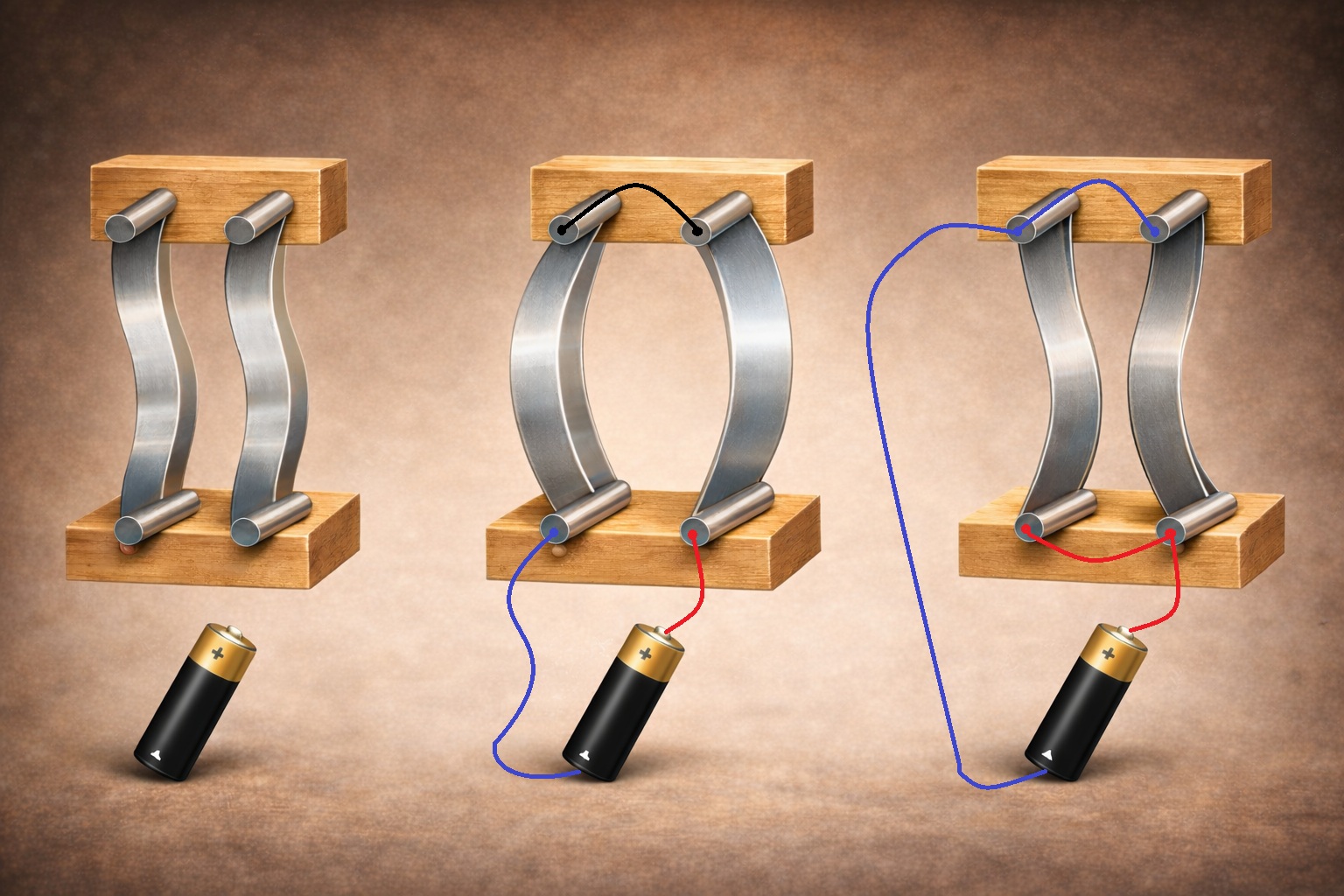
During these experiments he discovered an important phenomenon:
two conductors carrying electric current can attract or repel each other.
If the currents flow in the same direction, the conductors attract each other.
If the currents flow in opposite directions, the conductors repel each other.
This discovery provided the first clear evidence that electric currents produce magnetic interactions.
Magnetic Field of an Electric Current
Ampère’s experiments led to another important conclusion.
Whenever an electric current flows through a conductor, a magnetic field is created around it.
This magnetic field can influence:
- other conductors carrying current
- magnets
- magnetic needles such as those used in compasses
This discovery demonstrated that electricity and magnetism are closely related physical phenomena.
It also marked the beginning of a new scientific discipline known as electrodynamics.
Ampère’s Law
One of Ampère’s most important achievements was the formulation of a law that describes the interaction between electric currents.
Ampère’s Law relates several physical quantities:
- the strength of the electric current
- the magnetic effects produced by the current
- the geometry of the conductor and the surrounding space
This law became one of the fundamental principles of electromagnetism.
Even today it is used in the design and analysis of devices such as:
- electric motors
- generators
- transformers
- electromagnets
The Birth of Electrodynamics
Ampère’s work helped establish electrodynamics as a new field of physics.
Electrodynamics studies the behavior of moving electric charges and their interaction with magnetic fields.
Later scientists expanded upon Ampère’s ideas. Among the most important were:
- Michael Faraday, who discovered electromagnetic induction
- James Clerk Maxwell, who developed the mathematical theory of electromagnetism
Together, these discoveries formed the foundation of modern electrical science.
Why Ampère’s Discoveries Matter
Today it is difficult to imagine modern technology without the principles discovered by Ampère.
The interaction between electric currents and magnetic fields is the basis of many essential technologies, including:
- electric motors
- electric generators
- electromagnets
- transformers
- electrical measuring instruments
In fact, much of modern electrical engineering relies on the relationship between electricity and magnetism.
The Unit of Electric Current
To honor his contributions, the unit used to measure electric current was named after him.
This unit is called the ampere (A).
Whenever we say that a current of one ampere flows through a wire, we are indirectly referring to the scientist who first described the laws governing electric currents.
Ampère and Modern Electronics
Electric current is fundamental to nearly every modern technology.
It is used in:
- electronics
- power generation and distribution
- telecommunications
- transportation
- computing systems
Every electronic circuit operates because electric charges move through conductors and interact with electromagnetic fields.
The scientific understanding of these processes began with the work of André-Marie Ampère.
Summary
André-Marie Ampère was one of the pioneers of modern electrical science.
His research demonstrated that:
- electric current produces a magnetic field
- current-carrying conductors can attract or repel each other
- electricity and magnetism are closely related phenomena
Ampère’s discoveries marked the beginning of electrodynamics and played a crucial role in the development of modern electrical engineering.
Every time we measure electric current in amperes, we are using a unit that commemorates the scientist who helped uncover the laws governing electric currents.
Next
The history of electricity continues with other remarkable scientists whose discoveries shaped modern technology.
📘 Visit the Learning section for articles explaining the fundamentals of electricity and electronics.
🔧 Explore the Devices section to see how electrical principles are applied in real systems.
💬 Join discussions and ask questions on the Forum.
Understanding the history of science often helps us better understand modern technology.