Electric Current — The Movement of Electric Charges
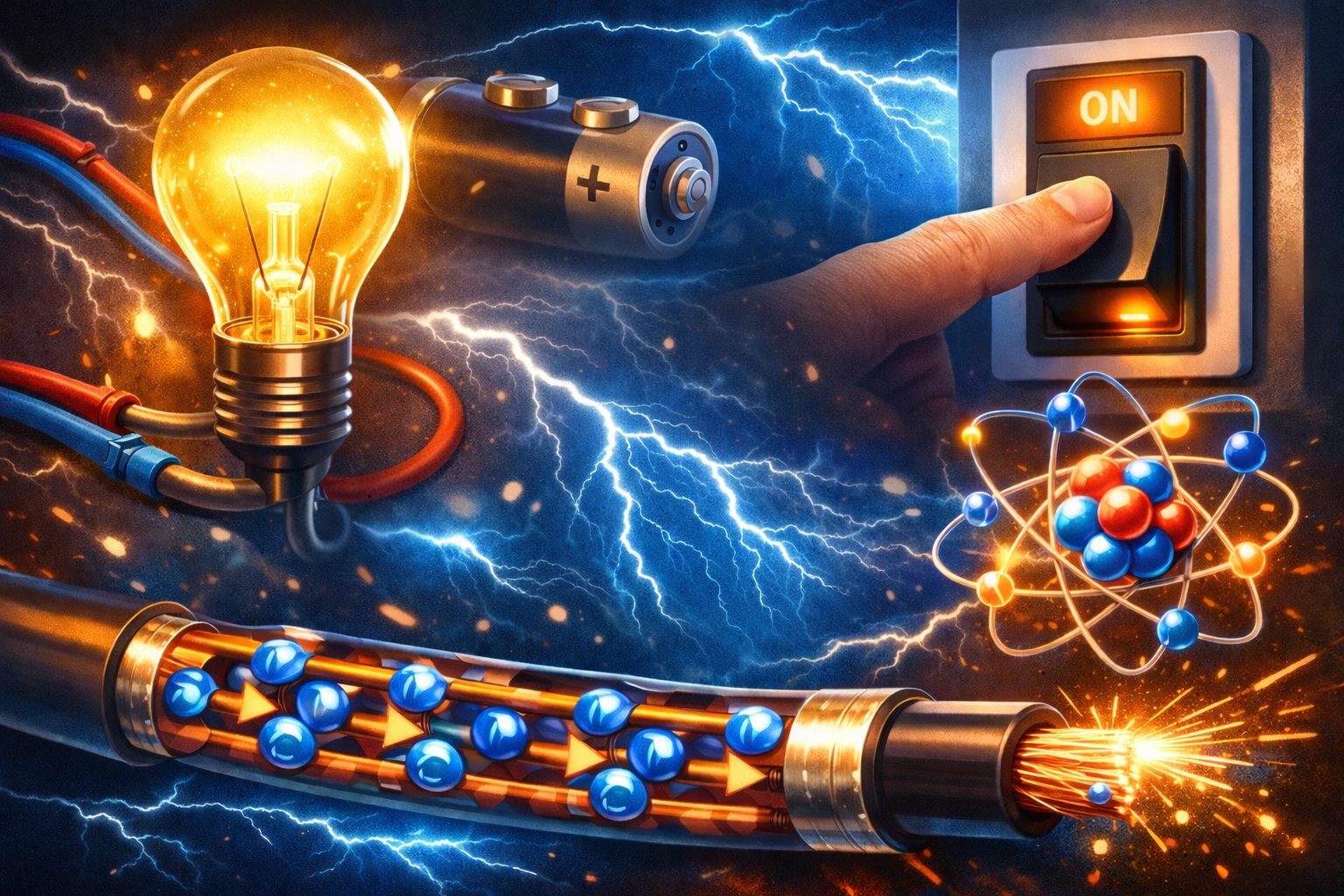
In the previous articles, we explored two important ideas.
First, we introduced the concept of electricity and learned that electrical phenomena are related to the existence of electric charges. Then we examined the structure of the atom and discovered that matter contains particles capable of carrying charge — such as electrons.
Now we can take the next step.
What exactly happens inside a conductor when we connect a battery or switch on an electrical device?
Why do electrons begin to move inside a wire?
And what exactly do physicists mean by electric current?
To answer these questions, we need to understand the nature of electric current.
What Is Electric Current?
Electric current is the ordered movement of electric charges.
The key word here is ordered.
Charged particles can move even when there is no electric current. For example, electrons inside a metal conductor are always in motion. They constantly collide with atoms, change direction, and move randomly through the material.
However, as long as this motion is random, there is no electric current.
Current appears only when a force begins to act on the charged particles, causing them to move mainly in one direction.
This directed movement of charges is what we call electric current.
Random Motion vs Directed Motion
To better understand the difference between ordinary particle motion and electric current, consider a simple analogy.
Imagine a large open square where people are walking in different directions.
Everyone moves independently and there is no overall flow.
This is similar to the random motion of electrons inside a metal.
Now imagine that the gates of a stadium open and people begin moving toward the exit.
A clear flow of movement appears.
Electric current is similar to this kind of flow — except that instead of people, charged particles are moving.
What Happens Inside a Metal Conductor
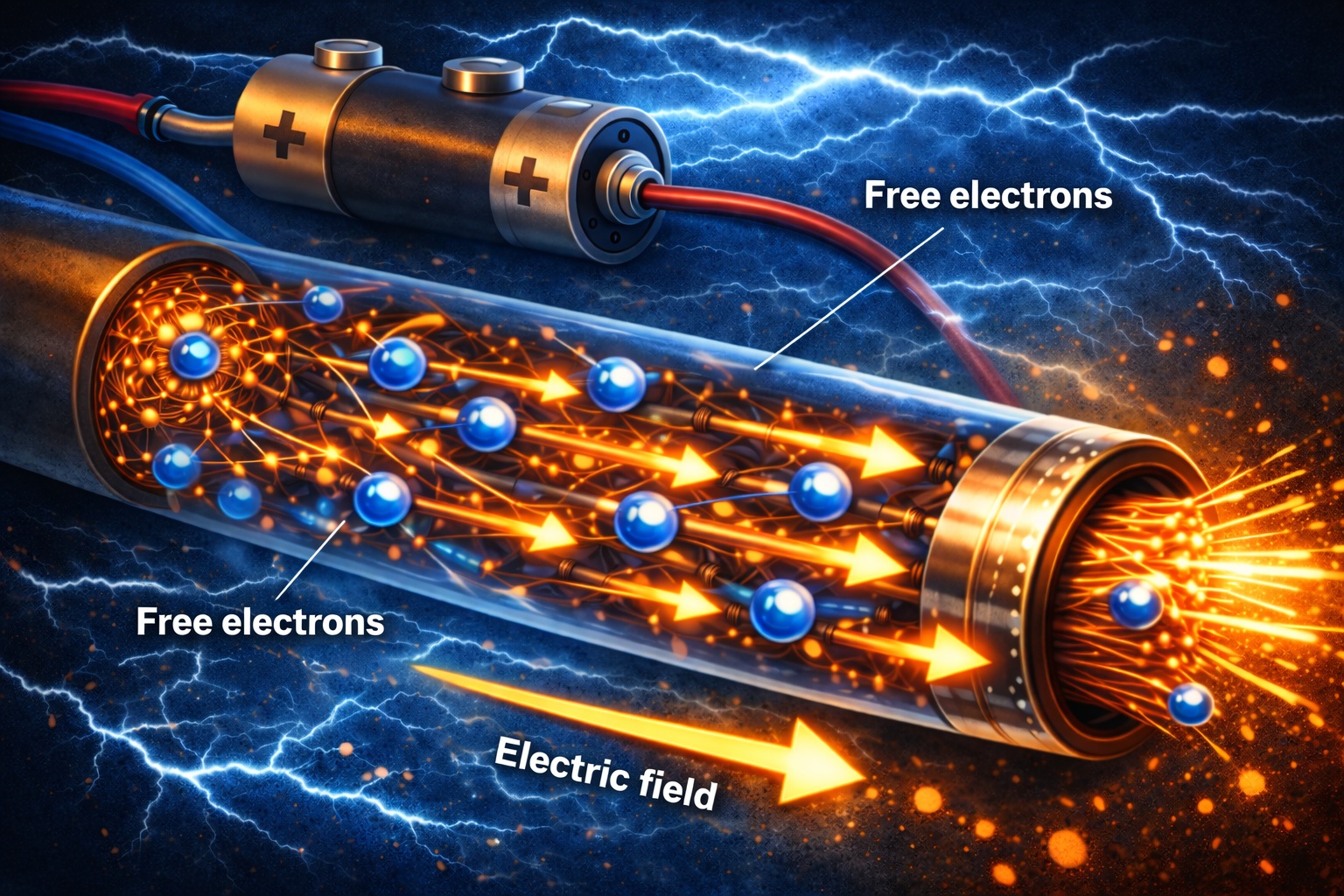
In metal conductors there are particles called free electrons. These electrons are not tied to a single atom and can move through the material.
Under normal conditions, their motion is random.
When a source of electrical energy — such as a battery or generator — is connected to a conductor, an electric field appears inside the material.
This electric field acts on the free electrons and causes them to slowly drift in a particular direction.
As a result, the random motion becomes organized, and an electric current appears in the conductor.
It is important to understand that electrons already exist inside the wire.
The power source does not create new electrons — it simply organizes their movement.
Direction of Electric Current
There is an interesting historical detail related to the direction of electric current.
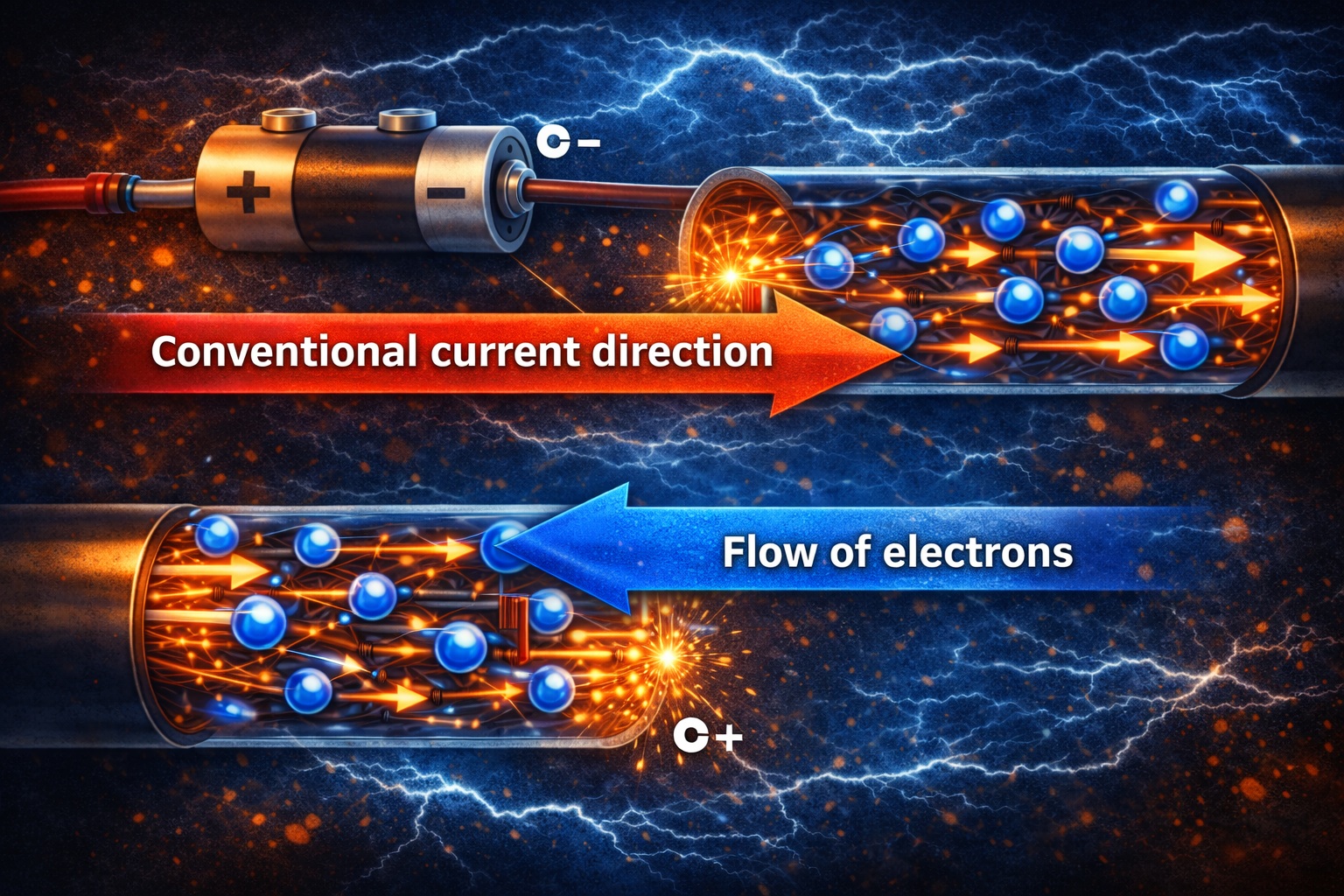
By convention, electric current is defined as flowing from the positive terminal to the negative terminal.
However, in metal conductors the actual charge carriers — electrons — move from the negative terminal to the positive terminal.
This difference exists because the concept of current direction was introduced before electrons were discovered.
For this reason, physics and electrical engineering use what is called the conventional current direction, which is opposite to the real movement of electrons.
This convention is used in all circuit diagrams and calculations.
Speed of Electron Motion
Many people imagine electric current as a stream of particles moving through wires at extremely high speeds.
In reality, the drift velocity of electrons is quite slow — typically only a few millimeters per second.
So why does a light bulb turn on almost instantly when we flip a switch?
The reason is that what spreads through the wire is the electric field, not the electrons traveling long distances.
When the circuit is closed, the electric field appears almost immediately throughout the entire circuit.
This can be compared to a long tube filled with small balls. If you push one ball at one end, the movement is transmitted almost instantly to the other end.
Each ball moves only a small distance, but the motion propagates through the whole system.
Electric Current (Current Intensity)
To describe electrical processes quantitatively, physicists use a quantity called electric current, often referred to as current intensity.
It describes how much electric charge passes through a cross-section of a conductor during a certain amount of time.
The more charge that passes through the conductor, the greater the current.
Electric current is measured in units called amperes (A).
For example:
• small electronic devices use milliamperes
• household appliances may draw several amperes
• powerful electric motors can use tens or even hundreds of amperes
Current is one of the fundamental quantities used to describe electrical circuits.
Why Wires Heat Up
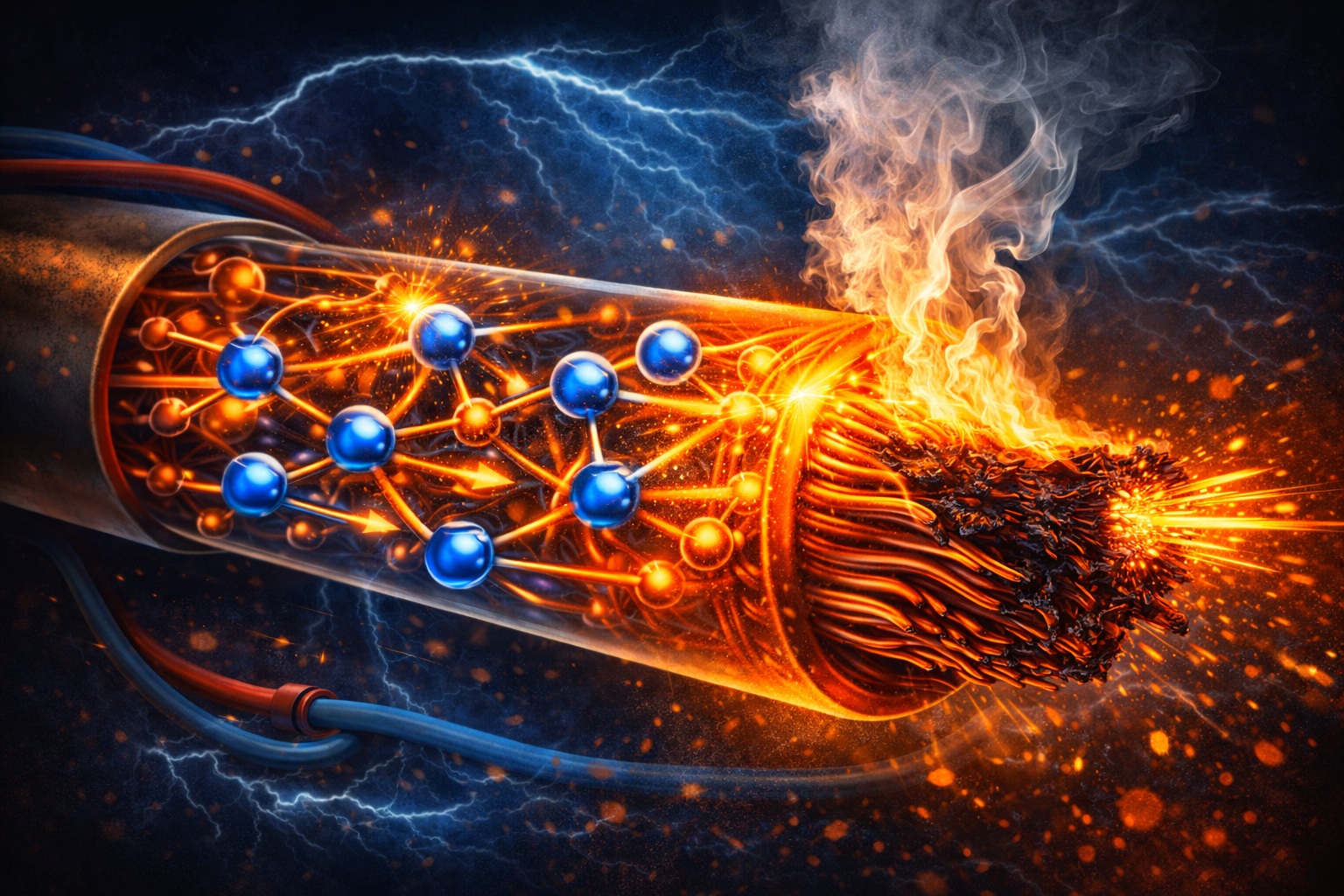
When electrons move through a conductor, they collide with the atoms that form the material's crystal structure.
These collisions resist the movement of electrons and create electrical resistance.
During this process, part of the electrical energy is converted into heat.
This is why:
• wires heat up when a large current flows
• very thin wires can overheat or burn out
• high-power devices require thicker cables
This phenomenon is known as electrical resistance, and we will study it in more detail in a later article.
Electric Current and Energy Transfer
Electric current is not only the movement of charges — it is also a way to transfer energy.
When current flows through a device, electrical energy can be converted into other forms of energy:
• light — in lamps
• heat — in electric heaters
• mechanical motion — in electric motors
• sound — in speakers
In this way, electric current allows energy to move through electrical circuits and power different devices.
Why Understanding Current Matters
Understanding the nature of electric current is one of the key steps in learning electronics and electrical engineering.
If current is seen only as a number in equations, electrical systems may seem abstract and complicated.
But once we understand what happens inside a conductor — how electrons move, how they interact with atoms, and how electric fields influence them — many electrical phenomena become much easier to understand.
Almost all modern technology works by controlling the movement of electric charges.
Summary
Let’s summarize the main ideas.
Electric current is the ordered movement of electric charges.
In metal conductors, current is created by the motion of electrons.
A power source produces an electric field that organizes the movement of these particles.
As electrons move through the material, they collide with atoms, which creates resistance and produces heat.
Thanks to electric current, electrical energy can be transmitted through wires and used to power many different devices.
Next Step
However, another important question arises.
If electric current is the movement of charges, what causes those charges to start moving?
In the next article, we will explore the concept of voltage and learn how it drives electric current in electrical circuits.
You can also:
🔧 visit the “Devices” section to see practical applications;
📘 continue learning in the “Education” section;
💬 ask questions or join the discussion on the Forum.