Electrical Resistance — Why Current Is Limited
In the previous articles, we learned that electric current is the movement of charges, and voltage is the cause that makes those charges move.
At first glance, it may seem that if voltage exists, electrons should move freely through a conductor.
However, this is not the case.
In reality, electric current is always limited.
This leads to an important question:
what exactly prevents electrons from moving freely?
The answer lies in a phenomenon known as electrical resistance.
What Is Electrical Resistance?
Electrical resistance is a property of a material that describes how strongly it opposes the flow of electric charges.
If we imagine current as a flow, resistance is what slows that flow down.
The greater the resistance:
- the harder it is for electrons to move
- the smaller the current at the same voltage
Resistance does not create motion — it limits it.
Why Electrons Do Not Move Freely
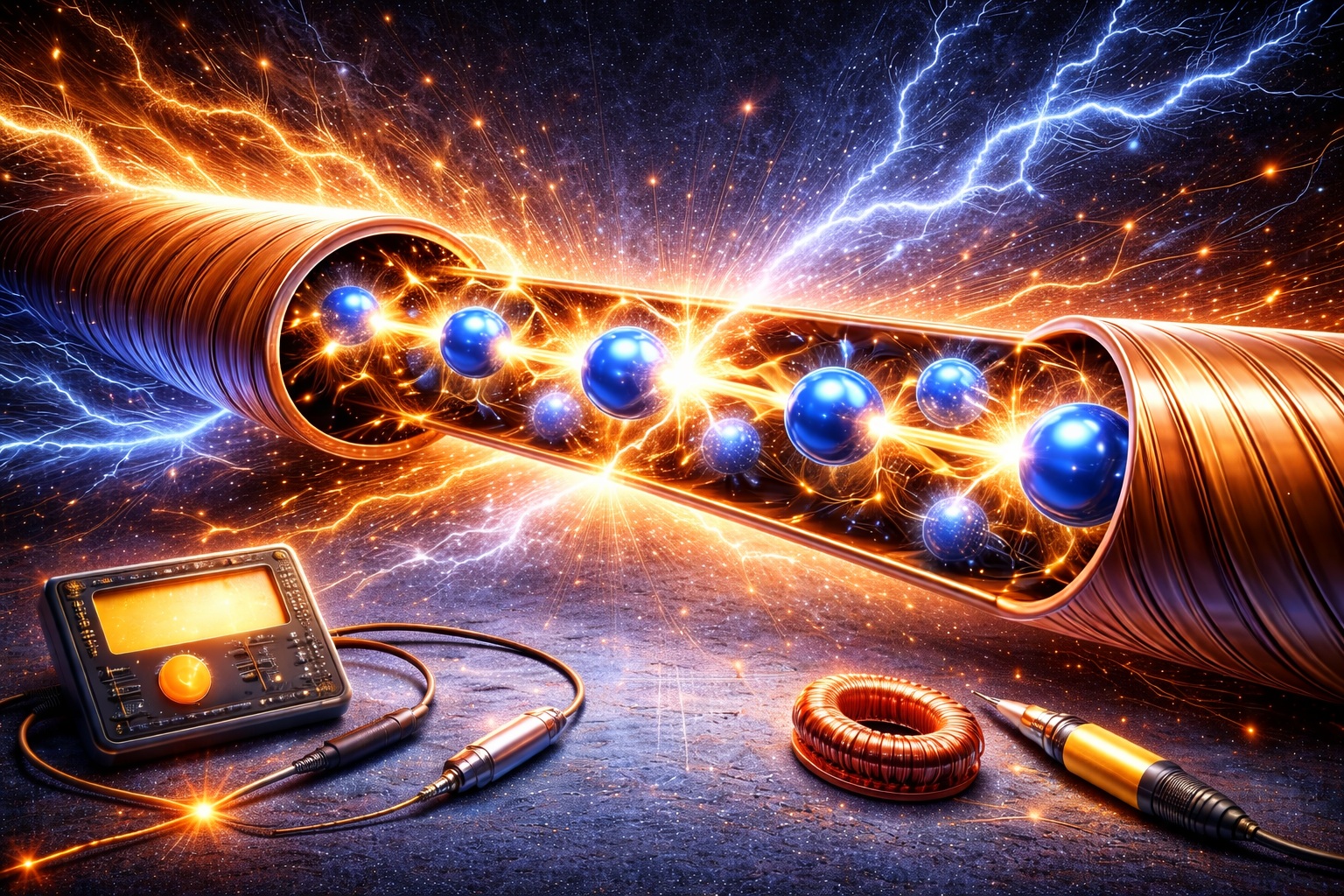
To understand resistance, we need to look inside a conductor.
A metal is not empty space. It consists of atoms arranged in a structure.
When electrons move through a material, they do not travel freely. Instead, they constantly:
- collide with atoms
- change direction
- lose part of their energy
These collisions happen extremely often — billions of times per second.
It is these interactions that create electrical resistance.
The more collisions occur, the higher the resistance.

An Intuitive Analogy
Imagine people walking through a corridor.
If the path is clear, movement is smooth and fast.
But if there are obstacles:
- crowds
- narrow passages
- other people
the movement slows down.
The same idea applies to electrons.
Resistance represents all the obstacles that electrons encounter as they move.
What Resistance Depends On
Resistance is not random — it depends on several physical factors.
Material
Different materials conduct electricity differently.
- copper has low resistance
- aluminum has slightly higher resistance
- rubber has extremely high resistance
That is why metals are used for wires, while insulating materials are used for protection.
Length of the Conductor
The longer the conductor, the farther electrons must travel.
This leads to more collisions and higher resistance.
Thickness of the Conductor
A thicker wire provides more space for electrons to move.
This reduces the number of collisions and lowers resistance.
Temperature
Temperature also affects resistance.
As temperature increases, atoms vibrate more strongly.
This makes it harder for electrons to move, increasing resistance.
Resistance and Energy
When electrons collide with atoms, they lose part of their energy.
This energy does not disappear — it is converted into heat.
That is why:
- wires heat up when current flows
- electric heaters work
- incandescent bulbs produce light
Resistance is directly related to the conversion of electrical energy into heat.
Unit of Resistance
Electrical resistance is measured in units called ohms (Ω).
This unit is named after Georg Ohm, who discovered the relationship between voltage, current, and resistance.
Resistance in an Electrical Circuit
Resistance is present in every electrical circuit.
Even a simple wire has some resistance.
Each component contributes:
- wires
- lamps
- resistors
- devices
The total resistance determines how much current flows through the circuit.
Why Resistance Is Important
Resistance plays a crucial role in electrical systems.
On one hand, engineers try to minimize it:
- in power lines
- in conductors
On the other hand, resistance is used intentionally:
- in heating elements
- in resistors
- in electronic circuits
Without resistance, it would be impossible to control electric current.
Resistance and Safety
Resistance is also essential for safety.
For example, insulation materials have very high resistance, preventing current from escaping.
If resistance becomes too low, a short circuit can occur.
This can lead to:
- overheating
- equipment damage
- fire
Common Misconceptions
❌ Resistance completely stops current
✔ It only limits it
❌ Wires have no resistance
✔ Every material has some resistance
❌ Resistance depends on voltage
✔ It depends on material and conditions
Intuitive Understanding
A simple way to remember:
👉 voltage pushes charges
👉 resistance opposes their movement
👉 current is the result
Summary
Electrical resistance is a property of a material that opposes the flow of electric charges.
It is caused by collisions between electrons and atoms.
Resistance depends on material, length, thickness, and temperature.
It is resistance that limits electric current and determines how circuits behave.
Next Step
Now we have three key concepts:
👉 voltage
👉 current
👉 resistance
How are they related?
In the next article, we will explore Ohm’s Law.
You may also
🔧 visit the “Devices” section to see practical applications;
📘 continue learning in the “Education” section;
💬 ask questions or join the discussion on the Forum.