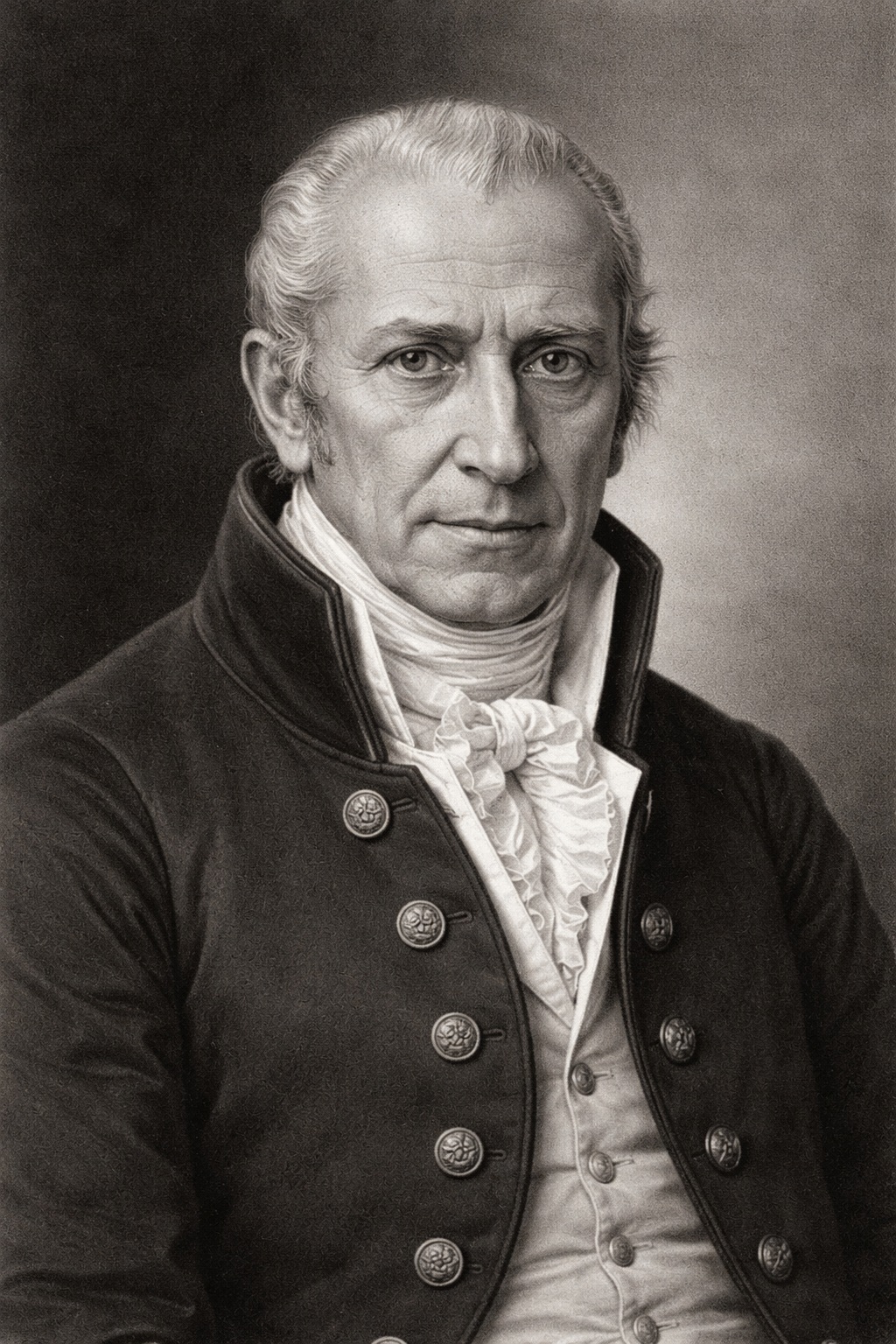
Alessandro Volta
Alessandro Volta was the first scientist to create a stable source of electric voltage. His invention, the voltaic pile, marked the beginning of electrochemistry and modern electrical engineering. We explore why this discovery became the foundation of electronics.
In electronics and electrical engineering, we use measurement units every day: volt, ampere, ohm.
Behind each of these names stands a person and an entire era of scientific discovery.
When we say “5 volts” or “12 volts,” we are effectively speaking the name of Alessandro Volta — the Italian scientist who first created a stable source of electric voltage. His work transformed electricity from a temporary effect into a controllable physical phenomenon and became the starting point of modern electrical engineering.
To understand the significance of this discovery, we must recall what electricity was like before Volta.
Electricity Before Volta
By the end of the 18th century, electricity was already known to scientists. Experiments with static electricity were conducted, sparks and discharges were observed, and Leyden jars were used to store charge.
However, these were short-lived phenomena. Electric charge was generated by friction or accumulation — and quickly disappeared. There was no source capable of delivering continuous current.
Electricity was seen as a spectacular effect but difficult to control. Research remained fragmented due to the absence of a stable experimental tool.
This is where Alessandro Volta enters the story.
Who Was Alessandro Volta
Alessandro Volta (1745–1827) was born in Como, Italy. He became a professor of physics at the University of Pavia and showed early interest in electrical phenomena.
Volta was distinguished by his experimental approach. He aimed not merely to observe effects, but to understand their nature and reproduce them under controlled conditions.
A key moment in his scientific career was his dispute with another Italian scientist — Luigi Galvani.
The Dispute with Galvani
Luigi Galvani conducted experiments with frog legs and observed muscle contractions when they came into contact with metal objects. He proposed the theory of “animal electricity.”
Volta disagreed. He argued that the source of the phenomenon was not biological tissue, but the contact between two different metals.
To prove his hypothesis, he systematically studied combinations of metal plates. The result was the invention of a device capable of generating a stable potential difference.
This scientific dispute ultimately led to the creation of the first battery.
The Voltaic Pile — The First Battery
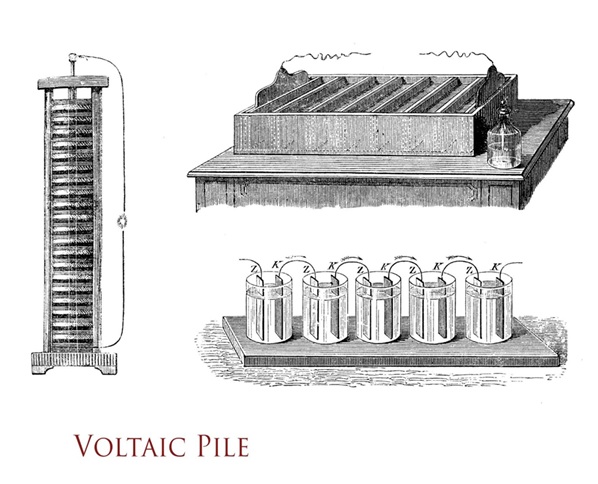
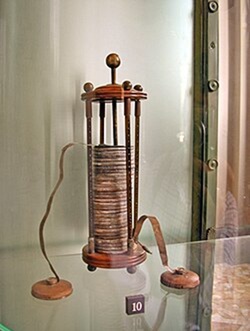
In 1800, Volta presented his invention — the voltaic pile.
The construction consisted of alternating metal plates:
• zinc
• copper
Between them were layers soaked in saltwater or a mild acid solution.
Each pair of plates produced a small potential difference. By connecting multiple pairs in series, Volta increased the total voltage.
For the first time, electricity could be generated continuously.
Electricity ceased to be a brief spark — it became controllable and measurable.
Why It Was Revolutionary
The appearance of the voltaic pile opened new possibilities.
For the first time, scientists could:
• study direct current,
• analyze the heating of conductors,
• observe chemical reactions caused by electricity,
• measure electrical quantities systematically.
Electrochemistry rapidly developed. Humphry Davy used batteries for electrolysis and discovered new chemical elements.
Without a stable voltage source, the laws of Ampère and Ohm would not have been formulated.
Volta’s invention became the foundation of all subsequent electrical engineering.
The Principle of Operation
The voltaic pile is based on chemical reactions.
Different metals have different tendencies to release electrons. In the presence of an electrolyte, a potential difference forms between them.
One metal becomes the source of electrons, the other their receiver. When connected by a conductor, electrons begin to move — electric current flows.
This principle underlies all modern batteries and accumulators.
Limitations of the Voltaic Pile
Despite its revolutionary nature, Volta’s invention had limitations.
The electrolyte would dry out over time.
Electrode polarization occurred.
The voltage was not fully stable.
These limitations stimulated further research and the development of improved power sources.
Recognition and Influence
Volta’s discovery gained widespread recognition in Europe. His work impressed Napoleon Bonaparte, who personally honored him and granted him the title of Count.
In 1881, decades after his death, the unit of electric potential was named in his honor — the volt (V).
From the Pile to Modern Electronics
Modern power sources are far more advanced:
• lithium-ion batteries,
• switching power supplies,
• voltage regulators,
• energy conversion systems.
However, the physical foundation remains the same:
voltage creates the conditions for charge movement.
Every electronic device begins with a power source.
Why It Matters Today
Volta’s story shows that electronics did not begin with microcontrollers and displays, but with understanding electric potential.
Without voltage, there is no charge movement.
Without charge movement, there is no current.
Without current, no device operates.
Conclusion
Alessandro Volta created the first stable source of electric voltage.
His invention:
• enabled systematic study of electric current,
• laid the foundation of electrochemistry and circuit theory,
• gave its name to the unit of voltage.
Modern electrical engineering began at that moment.
Continue Your Journey
If you’d like to go further:
🔧 Devices — analysis of real circuits and equipment.
📘 Education — structured materials on electronics fundamentals.
💬 Forum — questions, discussions, and shared experience.
Understanding history allows us to better comprehend modern electrical circuits.