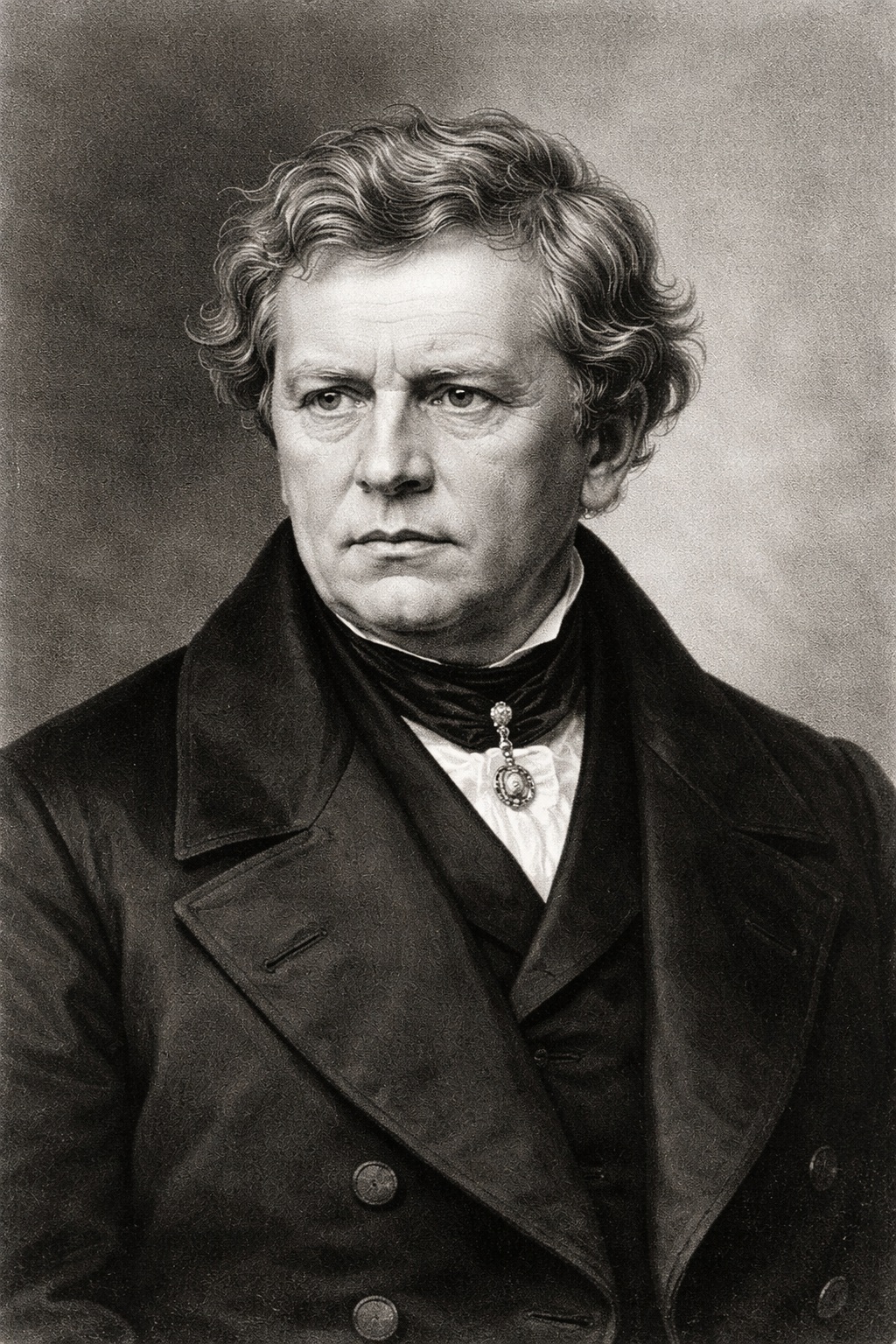
Georg Simon Ohm
Georg Ohm was the scientist who first described the precise relationship between voltage, current, and resistance. His law became the foundation of modern electrical engineering. Let’s explore how a simple equation changed the way we understand electric circuits.
In electrical engineering and electronics, we constantly use concepts such as voltage, current, and resistance.
These quantities form the basis of every electrical circuit.
However, for a long time they were treated as separate phenomena, without a clear connection between them.
Today, when we analyze circuits or apply formulas, we rarely think about the person behind these ideas.
That person was Georg Ohm.
Electricity Before Ohm
By the beginning of the 19th century, electricity was already being actively studied.
After the invention of a continuous voltage source by Alessandro Volta, scientists were finally able to work with steady electric current. This opened new possibilities for experimentation.
Researchers could observe:
- heating of conductors
- the behavior of current
- various electrical effects under controlled conditions
Yet one essential piece was still missing.
There was no clear understanding of how the key quantities were related:
- voltage
- current
- properties of materials
Experiments provided data, but there was no general law to describe or predict the behavior of electrical circuits.
Who Was Georg Ohm?
Georg Simon Ohm (1789–1854) was a German physicist and teacher.
He worked in a school and did not have access to advanced laboratory equipment. Despite this, he conducted experiments using the resources available to him.
What made Ohm unique was his approach.
He was not satisfied with simply observing electrical phenomena. He wanted to describe them mathematically.
Instead of asking “what happens?”, he asked:
👉 “how can this be expressed quantitatively?”
The Path to Discovery
Ohm began conducting systematic experiments with electrical circuits.
He varied different parameters:
- the length of conductors
- the material
- the applied voltage
And carefully measured how the current changed.
Over time, he noticed a consistent pattern.
He realized that current was not random — it followed a clear relationship depending on voltage and the properties of the conductor.
Ohm’s Law
In 1827, Ohm published his findings.
He showed that there is a simple relationship between voltage, current, and resistance:
👉 current increases with voltage
👉 and decreases as resistance increases
This relationship is now known as Ohm’s Law.
It became the first precise mathematical description of how an electrical circuit behaves.
Why It Was Important
Ohm’s discovery transformed the study of electricity.
Before his work, electrical research was largely descriptive.
After his work, it became possible to:
- calculate circuit behavior
- predict outcomes
- design electrical systems
Electricity was no longer just a subject of observation — it became a precise engineering discipline.
Recognition Came Later
Interestingly, Ohm’s work was not immediately accepted.
Many scientists at the time rejected his conclusions, considering them too simplistic.
However, as more experiments confirmed his results, his law gained recognition.
Eventually, it became one of the most important principles in physics and engineering.
The Unit of Resistance
In honor of Georg Ohm, the unit of electrical resistance was named the ohm (Ω).
Today, it is one of the fundamental units used in electrical science.
Every time we refer to resistance in ohms, we are using the name of the scientist who discovered this relationship.
Impact on Modern Electronics
Ohm’s Law is fundamental to modern electronics.
It is used:
- when designing circuits
- when analyzing electrical systems
- when selecting components
Without it, it would be impossible to understand how:
- resistors function
- power supplies operate
- electronic circuits behave
Even the most advanced technologies rely on the principles described by Ohm.
Connection to Learning
If you are studying the basics of electronics, you have already encountered three key concepts:
👉 voltage
👉 current
👉 resistance
Georg Ohm was the scientist who showed how these quantities are related.
👉 Go to the article: “Ohm’s Law — The Relationship Between Voltage, Current, and Resistance” (Education section)
Why It Still Matters Today
Ohm’s work shows that even a simple relationship can have enormous impact.
He did not invent a device or create a new material.
Instead, he did something more important:
👉 he connected fundamental concepts into a unified system
This made it possible to turn electricity into a precise and predictable science.
Summary
Georg Ohm established the relationship between voltage, current, and resistance.
His law:
- became the foundation of electrical engineering
- made circuit analysis possible
- is still used in every area of electronics
Every time we apply Ohm’s Law, we rely on the work of the scientist who first described the behavior of electric current mathematically.
Next
📘 Visit the Education section for articles explaining the fundamentals of electricity and electronics.
🔧 Explore the Devices section to see how electrical principles are applied in real systems.
💬 Join discussions and ask questions on the Forum.
Understanding the history of science helps us better understand modern technology.