Ohm’s Law — The Relationship Between Voltage, Current, and Resistance
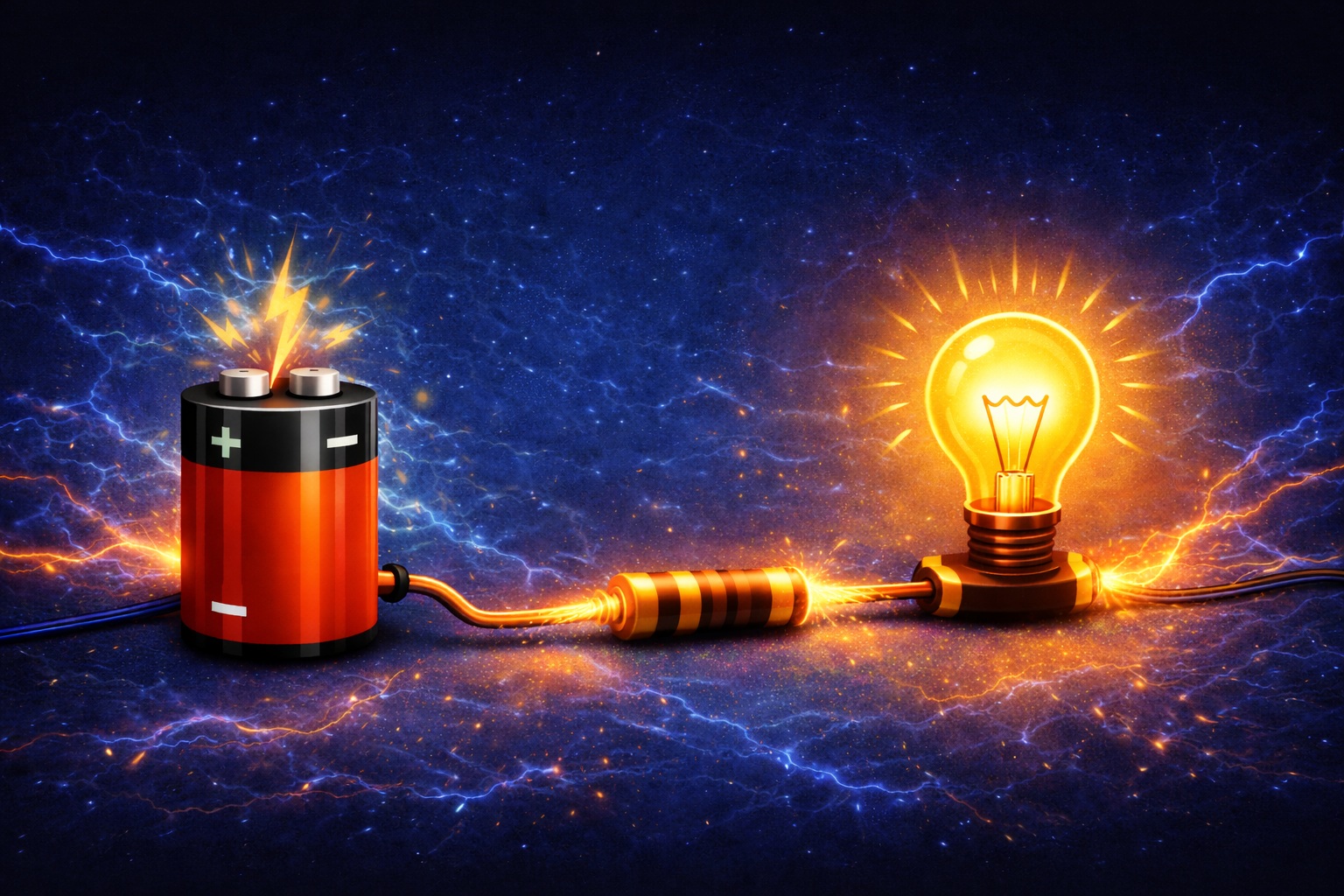
In the previous articles, we introduced three fundamental concepts:
voltage — what causes charges to move
current — the movement of electric charges
resistance — what limits that movement
Each of these concepts is important on its own.
However, a true understanding of electrical circuits comes only when we see how they are connected.
This connection is described by Ohm’s Law.
How This Relationship Was Discovered
At the beginning of the 19th century, electricity was already being actively studied.
With the invention of reliable voltage sources, scientists were able to perform controlled experiments with electric current.
Despite this progress, the behavior of circuits remained difficult to predict.
There was no clear answer to questions such as:
how current changes when voltage increases
how materials affect current
why different circuits behave differently
German physicist Georg Ohm conducted a series of experiments and discovered that these quantities are linked by a precise relationship.
👉 Learn more about him in the article “Georg Ohm” in the “Notable Figures” section.
The Essence of Ohm’s Law
Ohm’s Law describes the relationship between voltage, current, and resistance.
It shows that current in a circuit is determined by two opposing factors:
the force that drives it and the resistance that limits it.
In simple terms:
the higher the voltage, the greater the current
the higher the resistance, the smaller the current
Ohm’s Law Formula
This relationship is expressed as:
👉 I = U / R
where:
I — current
U — voltage
R — resistance
It is important to understand that this formula applies to a section of a circuit where voltage and resistance are known.

What This Formula Means
Ohm’s Law represents a balance between two effects.
Voltage creates an electric field that pushes charges.
Resistance opposes their movement due to interactions within the material.
The resulting current depends on both.
This can be expressed intuitively:
👉 voltage pushes
👉 resistance opposes
👉 current is the result
Example of Ohm’s Law
To better understand Ohm’s Law, consider a simple example.
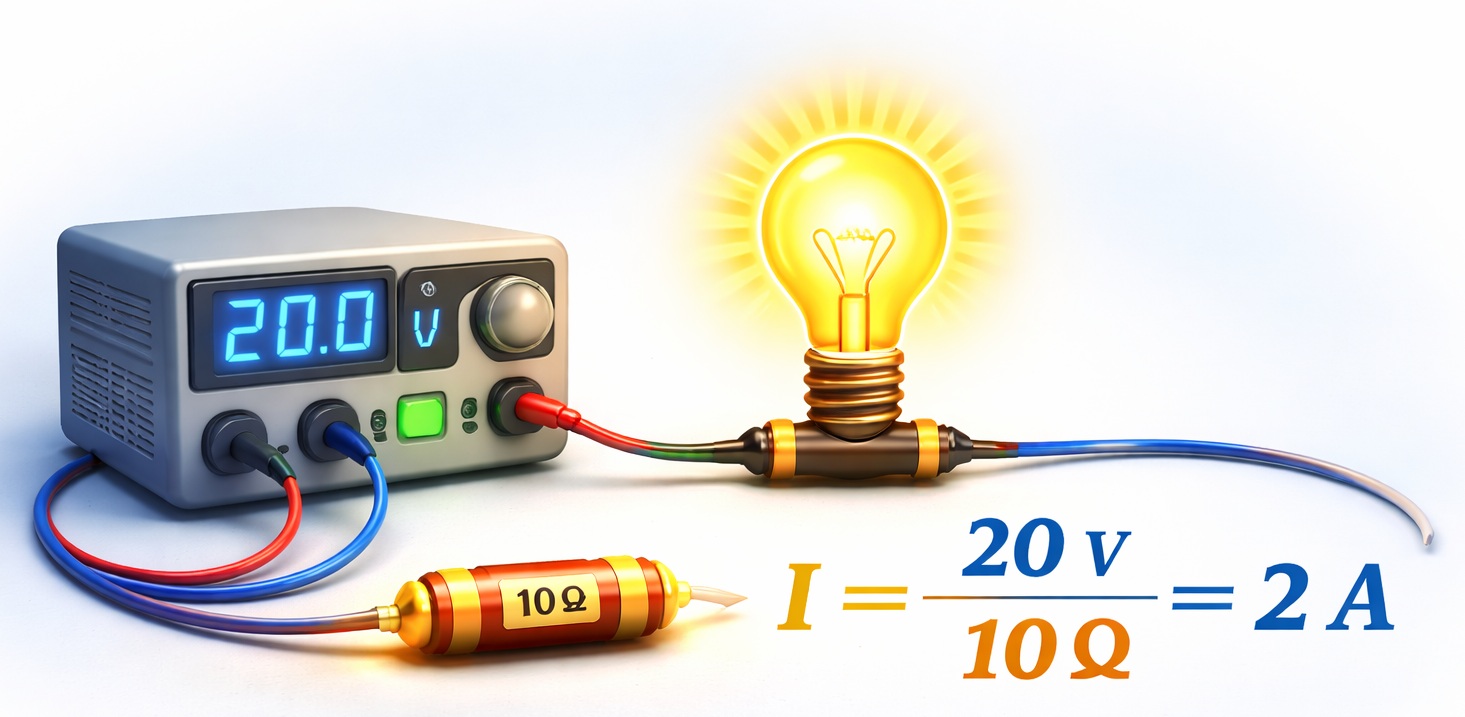
Imagine a lamp with a resistance of 10 ohms, connected to a 20-volt power source.
We want to calculate the current.
Using the formula:
👉 I = U / R
Substitute the values:
👉 I = 20 / 10 = 2 A
This means that a current of 2 amperes flows through the lamp.
Such calculations allow us to predict how a device will behave in a circuit.
Why This Matters in Practice
Ohm’s Law is not just a theoretical concept.
It is used constantly in real-world applications.
It allows engineers and technicians to determine:
- how much current will flow
- whether a wire can handle the load
- whether a component is suitable
- whether a circuit may overheat
That is why it is one of the most important tools in electrical engineering.
Ohm’s Law for a Complete Circuit
The formula we discussed applies to a part of a circuit.
When analyzing a complete circuit, the power source must also be considered.
A source is characterized by:
electromotive force (EMF)
internal resistance
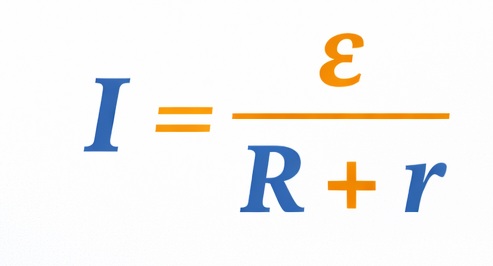
In this case, Ohm’s Law takes the form:
👉 I = ε / (R + r)
where:
ε — EMF of the source
R — external resistance
r — internal resistance
This means that part of the energy is lost inside the source itself.
Ohm’s Law for Alternating Current
In alternating current (AC) circuits, the situation becomes more complex.
Voltage and current change over time and may be out of phase.
Additional effects appear due to:
inductance
capacitance
These effects are combined into a quantity called impedance (Z).
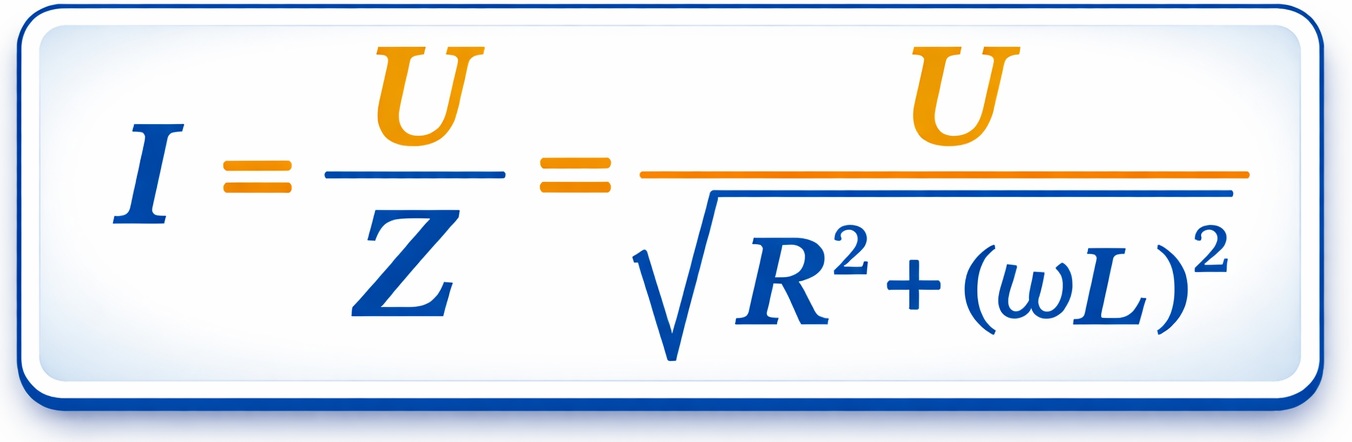
Ohm’s Law is then written as:
👉 I = U / Z
where Z is the total opposition to current.
Despite the added complexity, the core idea remains the same:
voltage determines current, and resistance (in a broader sense) limits it.
Even in more advanced systems, Ohm’s Law still applies in a generalized form.
Why Ohm’s Law Is So Important
Ohm’s Law is the foundation of electrical engineering and electronics.
It makes it possible to:
- analyze circuits
- predict behavior
- design electrical systems
Without it, even simple circuits would be difficult to understand.
Connection to Previous Topics
We can now combine everything we have learned:
voltage causes motion
resistance limits it
current is the result
Ohm’s Law connects these ideas into a single system.
Summary
Ohm’s Law describes the relationship between voltage, current, and resistance.
The formula I = U / R is used to calculate current in a section of a circuit.
In more advanced cases, additional factors such as internal resistance and impedance must be considered, but the fundamental principle remains unchanged.
Next Step
Now a new question arises:
👉 how much energy does a device consume?
In the next article, we will explore electrical power.
You may also
🔧 visit the “Devices” section to see practical applications;
📘 continue learning in the “Education” section;
💬 ask questions or join the discussion on the Forum.