Voltage — What Makes Current Flow
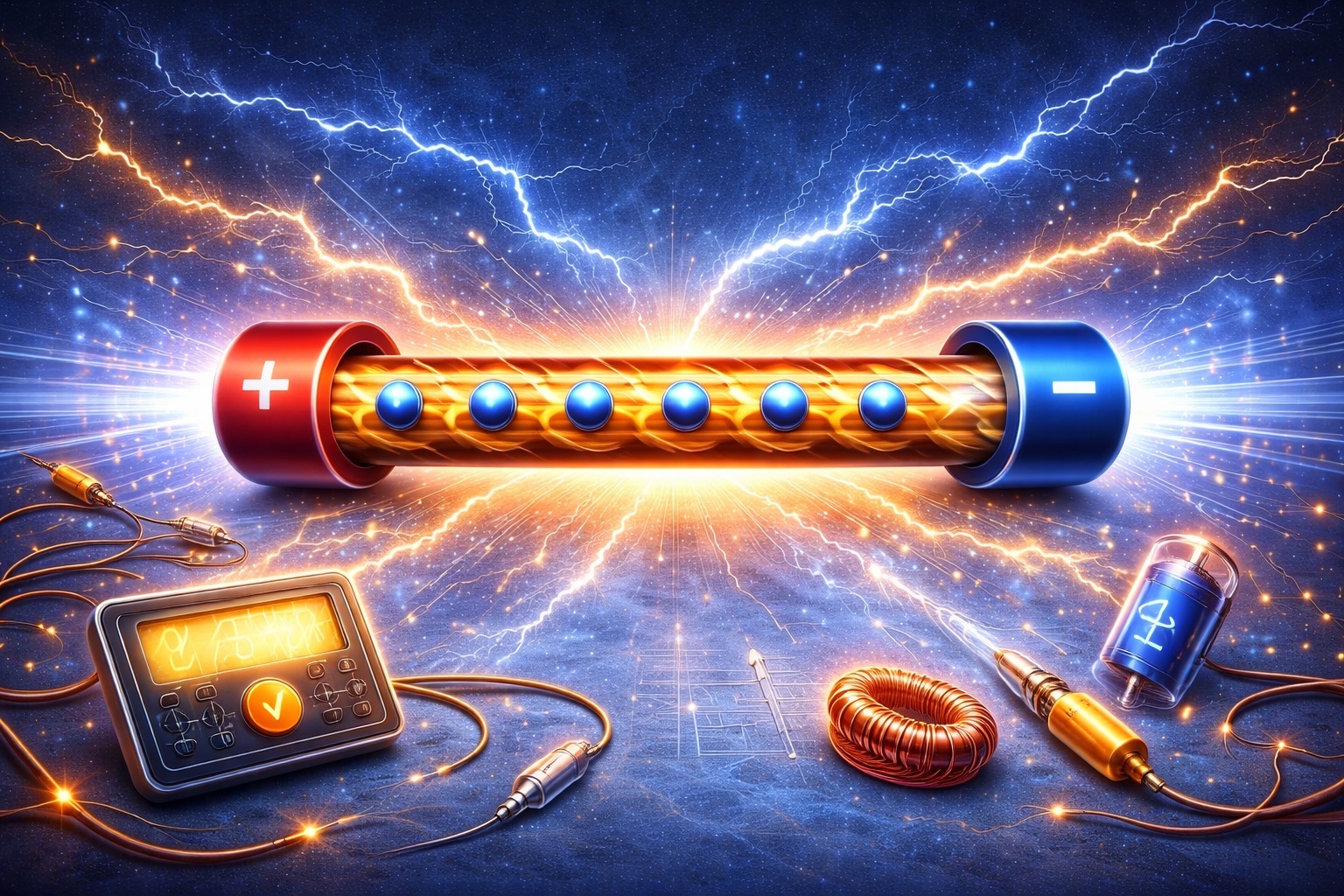
In the previous article, we explored where electricity comes from and how energy sources such as batteries and generators work.
We learned that these devices create the conditions necessary for electric charges to move.
But this leads to an important question.
What exactly causes electrons to move?
What physical mechanism is responsible for the flow of electric current?
The answer is electric voltage.
What Is Voltage?
Voltage is a physical quantity that describes how strongly an electrical energy source acts on charges.
More precisely:
Voltage is the difference in electric potential between two points in a circuit.
This difference creates the force that causes charges to move.
Without voltage:
- there is no directed motion of charges
- there is no electric current
This definition may seem abstract at first, so it helps to express the main idea more simply.
Key Idea
🔎 Important to remember
Voltage is not current.
But voltage creates the conditions that allow current to exist.
Water Analogy
To better understand voltage, consider a simple analogy.
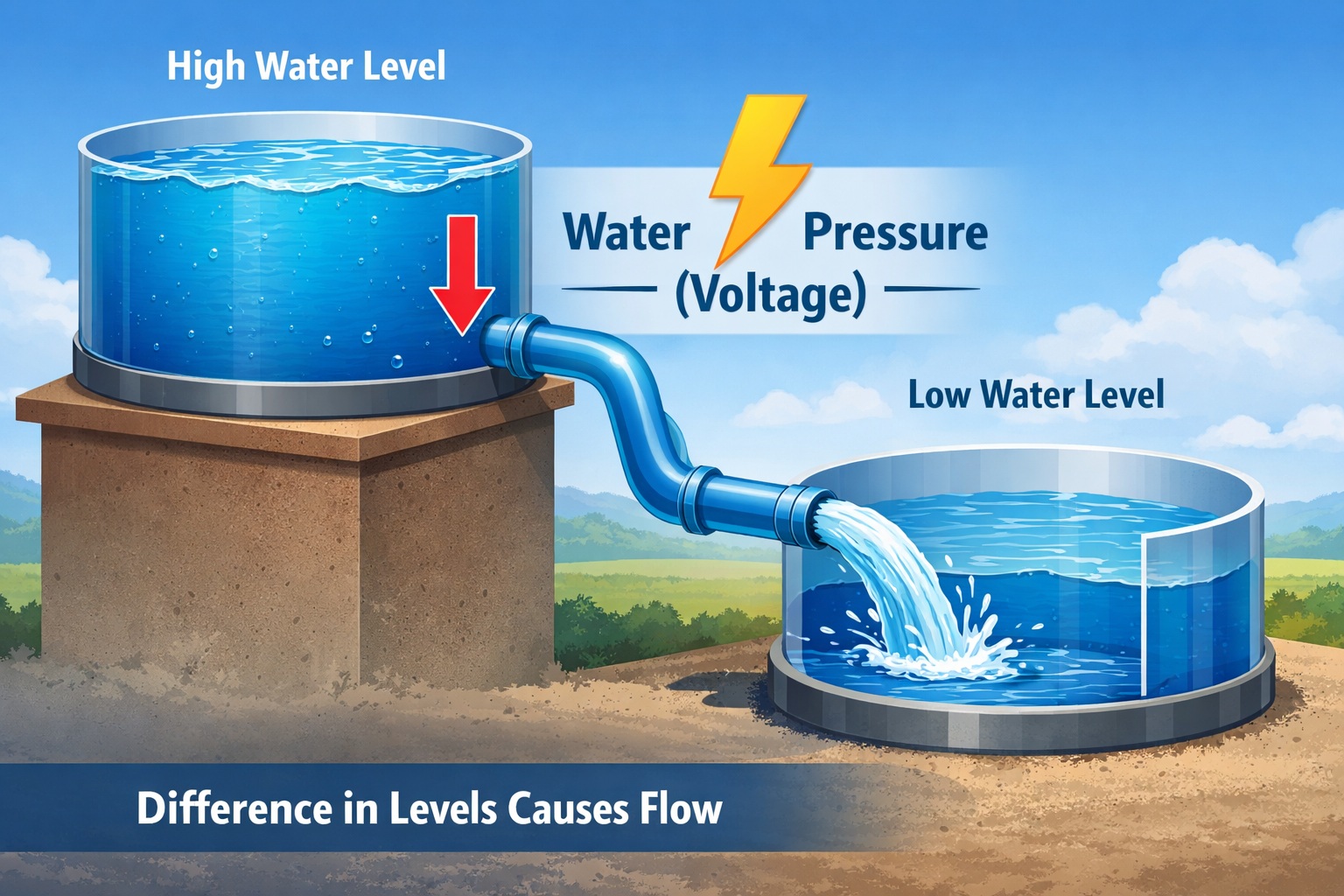
Imagine two water tanks.
If the water level is the same in both tanks, no water flows.
But if one tank is higher than the other, water begins to flow downward.
The reason is the difference in height.
Electricity behaves in a similar way.
Voltage is like the difference in levels that causes charges to move.
Potential Difference
Every point in an electrical circuit has its own electric potential.
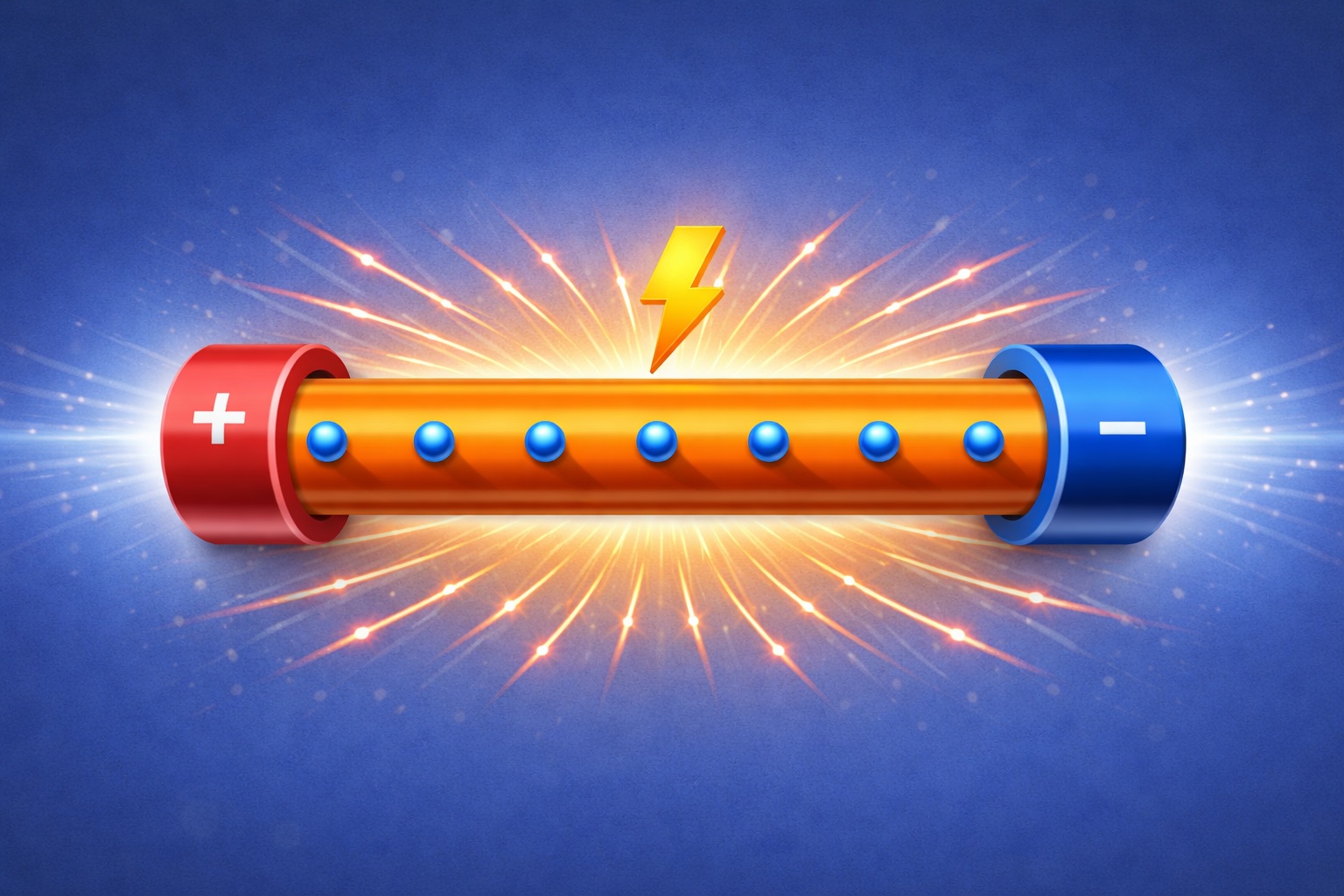
A power source creates a difference in potential between its terminals:
- one terminal has a higher potential
- the other has a lower potential
When the circuit is closed, charges begin to move from one point to another.
This difference in potential is what we call voltage.
How Sources Create Voltage
Different energy sources generate voltage in different ways:
Battery
Through chemical reactions.
Generator
Through motion in a magnetic field.
Solar Panel
Through light (photoelectric effect).
Despite the different mechanisms, the result is always the same:
👉 a potential difference is created
👉 an electric field appears
👉 charges begin to move
Voltage and Electric Field
Voltage is directly related to the electric field.
When a potential difference exists, an electric field forms inside the conductor.
This field acts on charges and causes them to move.
You can think of it as a force acting on every charged particle.
👉 voltage creates the field
👉 the field moves electrons
👉 electron movement is current
Voltage and Energy
Voltage is not only related to motion — it is also related to energy.
It describes how much energy each charge receives as it moves through a circuit.
In other words:
👉 voltage tells us how much energy is transferred per unit of charge
The higher the voltage:
- the more energy each charge carries
- the stronger its effect on the circuit
This is why higher voltage allows more energy to be delivered.
Unit of Voltage
Voltage is measured in units called volts (V).
This unit is named after Alessandro Volta.
Examples:
- battery — 1.5 V
- USB — 5 V
- household mains — 230 V
Higher voltage means a stronger effect on charges.
Voltage in Real Devices
Voltage is present in all electrical devices.
For example:
- a smartphone battery — about 3.7 V
- a laptop — around 19 V
- household appliances — 230 V
Each device is designed to operate at a specific voltage.
If the voltage is too low, the device will not work.
If it is too high, the device may be damaged.
Voltage and Current
It is important to understand:
👉 voltage is not current
👉 but voltage causes current
The relationship is simple:
- if there is voltage → current can flow
- if there is no voltage → no current flows
However:
👉 current also depends on resistance
(this will be explained in Ohm’s Law)
Voltage in Open and Closed Circuits
Voltage can exist even when no current flows.
For example, in a battery that is not connected to anything:
- there is voltage between its terminals
- but no current flows
This is called an open circuit.
Current appears only when the circuit is closed.
Therefore:
👉 voltage can exist without current
👉 current cannot exist without voltage
How Voltage Is Distributed
Voltage is not only present at the source — it is distributed throughout the circuit.
If a circuit contains multiple components, the voltage is divided between them.
This is known as voltage drop.
Because of this:
- lamps produce light
- heaters generate heat
- motors create motion
Energy from the electric field is transferred and converted into other forms.
Voltage Inside a Conductor
Voltage exists along the entire length of a conductor.
Inside it, an electric field is present that:
- acts on electrons
- directs their motion
This field exists throughout the circuit.
That is why when a circuit is closed, the movement of charges begins almost simultaneously everywhere.
Common Misconceptions
❌ Voltage is the same as current
✔ Voltage causes current
❌ If voltage exists, current always flows
✔ Not in an open circuit
❌ Voltage “flows” through wires
✔ Charges flow, voltage describes the field
❌ Higher voltage always means higher current
✔ Current also depends on resistance
These misconceptions occur because voltage and current are often confused, even though they play different roles.
Intuitive Understanding
A simple way to think about it:
👉 voltage is the “pressure” on charges
👉 current is the result of their movement
Or even simpler:
👉 voltage pushes
👉 current flows
Why Voltage Can Be Dangerous
High voltage can be dangerous to humans.
It can:
- drive current through the body
- damage tissues
- cause electric shock
Even relatively low voltages can be dangerous under certain conditions.
That is why safety precautions are essential when working with electricity.
Why Understanding Voltage Matters
Voltage is one of the most fundamental concepts in electrical engineering.
Every circuit starts with the question:
👉 what voltage is applied?
Without understanding voltage, it is impossible to:
- analyze circuits
- design systems
- understand how devices work
Summary
Voltage is the difference in electric potential between two points.
It is the cause of charge movement and electric current.
Without voltage, current cannot exist.
Voltage is related to energy transfer and is measured in volts.
Next Step
This leads to another important question.
If voltage causes current to flow, then:
👉 what limits that current?
In the next article, we will explore electrical resistance.
You may also
🔧 visit the “Devices” section to see practical applications;
📘 continue learning in the “Education” section;
💬 ask questions or join the discussion on the Forum.